Do Narcissists Love? How Affection Can Feel Real but Stay Conditional
When you search "do narcissists love," you are probably not asking a cold theory question. You may be trying to understand why someone could seem devoted one week and dismissive the next, or why affection felt intense but rarely safe. The careful answer is that some people with strong narcissistic traits can feel attachment, desire, pride, tenderness, and fear of loss. The harder question is whether that feeling becomes steady, mutual love. For many people dealing with narcissistic patterns, the relationship works better when you judge love by repeated behavior over time, not by dramatic words. If you want a private way to reflect on patterns you are seeing, the narcissistic traits reflection tool can be a gentle starting point, not a professional evaluation.

The Short Answer: Love Can Be Present, but It May Not Be Mutual Enough
The most useful distinction is between feeling love and practicing love. A person with narcissistic traits may feel a powerful emotional pull. They may miss you, idealize you, want your attention, or feel proud to be connected to you. Those feelings can be real to them.
But mutual love asks for more than intensity. It asks for empathy when you are inconvenient, accountability after harm, respect for your separate inner life, and care that does not vanish when admiration fades. Narcissistic traits can make those skills inconsistent because the person may center their needs, status, discomfort, or self-image before the relationship itself.
That is why the same relationship can feel confusing. At certain moments, the affection may look sincere. At other moments, it may feel conditional, performative, or dependent on whether you are validating them. The key question becomes: do their loving moments translate into stable care, repair, and respect?
What Narcissistic Love Often Looks Like Over Time
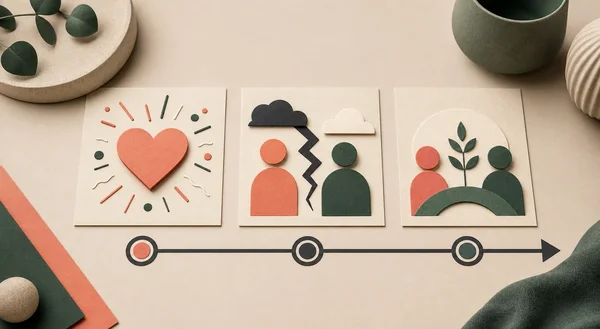
Narcissistic love patterns often begin with intensity. This does not mean every enthusiastic beginning is harmful. Many healthy relationships start with excitement. The concern is speed plus pressure plus poor respect for boundaries.
Love bombing can feel like proof, but it is not enough
Love bombing is excessive attention, praise, fast commitment, or future talk that arrives before trust has had time to form. It may sound like, "You are perfect," "No one understands me like you," or "We are meant to be together" after only a short time.
The confusing part is that the person may believe some of what they are saying in that moment. They may be in love with the feeling, the fantasy, the validation, or the version of you they have imagined. The problem appears when ordinary reality arrives. You have limits, preferences, needs, and imperfect days. If affection drops sharply once you stop matching the fantasy, the early intensity was not the same as mature love.
Devaluation reveals whether care can survive disappointment
In a healthier bond, disappointment leads to conversation. In a narcissistic pattern, disappointment may lead to criticism, contempt, comparison, withdrawal, jealousy, or control. You may feel pushed to keep proving that you are still worthy of warmth.
This stage matters because love is tested most clearly when the other person is frustrated. Can they stay curious? Can they apologize without making you comfort them? Can they hear "no" without punishing you? If not, the relationship may be organized around their emotional regulation rather than mutual care.
Do Narcissists Love Their Wife, Partner, or Empath?
A narcissistic partner may love the role you play: the admiration you offer, the stability you provide, the way you make them look, or the emotional availability you keep giving. They may also feel genuine tenderness at times. Those two realities can coexist.
For a wife, husband, partner, or empathic person, the practical test is not whether the narcissistic person ever feels affection. It is whether the relationship leaves room for both people. If one person's needs are treated as central and the other person's needs are treated as interruptions, the bond may become emotionally expensive.
People who are highly empathic can be especially vulnerable to explaining away repeated harm. They may think, "If I understand them better, they will finally feel safe enough to love me well." Understanding can help you respond calmly, but it should not require you to ignore repeated disrespect. The private narcissism self-reflection resource can help organize what you are noticing, while serious relationship distress is best discussed with a qualified professional or trusted support system.
Five habits that make love feel unstable
Common narcissistic habits that can weaken love include needing admiration to feel steady, avoiding responsibility, turning conflict into blame, struggling with empathy when ashamed, and treating boundaries as rejection. These habits do not prove what someone is or is not. They are patterns to watch because they affect how safe the relationship feels.
If someone says they love you but repeatedly mocks your feelings, punishes your independence, or refuses repair, the word "love" may not be enough to protect your well-being.
Do Narcissists Love Their Children, Mothers, or Family?
Questions about family are especially painful because the stakes are so personal. Do narcissists love their child? Do narcissists love their mothers? Do narcissistic parents love their children? The answer can vary by person, but narcissistic traits may distort family love in recognizable ways.
A narcissistic parent may feel proud of a child, protective in public, or emotionally attached. Yet the child may also be treated as an extension of the parent's image. Love may become easier when the child performs well, agrees, admires, or reflects positively on the parent. It may become colder when the child has separate needs, emotions, or boundaries.
With mothers, fathers, siblings, or adult children, the same pattern can appear: warmth when the relationship supports the narcissistic person's self-image, defensiveness or control when it does not. This does not mean every difficult family member has narcissistic traits. It means family closeness should still include respect, age-appropriate boundaries, and emotional safety.

Do Narcissists Love Themselves or Animals?
"Do narcissists love themselves?" is trickier than it sounds. Grandiosity can look like self-love, but it may be closer to self-protection. A person can appear confident while depending heavily on praise, comparison, status, or control to avoid shame. That kind of self-focus is not the same as stable self-respect.
Animals can also bring mixed answers. Some people with narcissistic traits may show real affection for pets, especially when the pet provides loyalty, comfort, or admiration without complex emotional demands. Others may be neglectful, controlling, or inconsistent. As with human relationships, behavior over time matters more than labels.
The wider point is simple: love is not only an emotion someone claims to have. It is a pattern of care, patience, and responsibility that can be observed.
Can a Narcissist Fall in Love Permanently?
A narcissist can fall in love in the sense of intense attraction or attachment. Permanent, stable love is harder when the person cannot tolerate ordinary disappointment, share power, or repair harm. Long-term love needs flexibility. It asks each person to update the fantasy and keep caring for the real human being in front of them.
Narcissistic patterns can improve when a person develops insight, accepts responsibility, practices empathy, and stays engaged in meaningful personal work. But improvement is not something a partner can force by being more patient, more loyal, or more understanding. If you are waiting for change, look for sustained actions: honest accountability, respect for boundaries, reduced blame, and consistent effort even when there is no immediate reward.
It is reasonable to hope. It is also reasonable to protect yourself while you watch what actually happens.
Use the Question to Protect Your Clarity
The question "do narcissists love" can keep you stuck if it becomes a search for a perfect answer about someone else's inner world. A more useful question is: what does this person's version of love require from me, and what does it cost?
Try a brief reality check:
- Do their loving words match their behavior over months, not just days?
- Can they show concern when your needs compete with theirs?
- Do they repair harm without turning themselves into the only injured person?
- Are your boundaries respected, or treated as betrayal?
- Do you feel more like a partner, a parent, an audience, or a possession?
If these questions bring up worry, you do not have to rush toward a label. You can slow down, write down patterns, talk with a trusted person, and consider professional support if the relationship feels unsafe or overwhelming. For a low-pressure starting point, you can also explore the free narcissistic traits screening guide as an educational reflection tool.

FAQ
Can a narcissist truly love someone?
Some people with narcissistic traits can feel attachment, desire, tenderness, or fear of losing someone. The harder question is whether they can practice mutual love consistently. Look for empathy, accountability, respect for boundaries, and care when they are disappointed.
What do narcissists do when they love you?
They may praise you, pursue closeness, seek your attention, make plans, or show affection. In a healthier pattern, those behaviors are paired with respect and repair. In a narcissistic pattern, affection may become conditional on admiration, control, or the role you play for them.
Do narcissists love their child?
Some may feel real attachment to a child, but narcissistic traits can make the relationship conditional. A child may be valued when they reflect well on the parent and criticized when they express separate needs. Children still need steady care, safety, and age-appropriate boundaries.
Do narcissists love their wife, husband, or partner?
They may feel love or attachment, but the relationship can become uneven if their needs always outrank yours. Watch whether they can respect your separate feelings, accept feedback, and repair harm. A loving label does not replace consistent care.
Do narcissists love themselves?
They may appear self-loving because of confidence, grandiosity, or self-focus. Underneath, some rely heavily on admiration and control to manage inner shame. Stable self-love is calmer: it allows accountability, empathy, and respect for others.
Can narcissistic patterns improve?
They can improve when the person recognizes the pattern, takes responsibility, and does sustained personal work. A partner cannot create that change for them. Pay attention to long-term behavior rather than promises made during conflict.
Is it better to outsmart a narcissist or set boundaries?
Boundary-setting is usually healthier than trying to outsmart someone. Keep communication clear, reduce emotional escalation where possible, document important interactions when needed, and seek support if the relationship feels unsafe, coercive, or exhausting.